

The WHO/UNICEF launched the release of 2026 Joint Monitoring Program Report. It’s a biannual report highlighting the world wide status of Water, Sanitation, and Hygiene (WASH) in Health Care Facilities (HCFs). And this year’s report includes data on Environmental Cleaning and Waste Management for the first time.
The report includes data from 83 countries. However, the data from the Democratic Republic of the Congo is based upon 2022 input.
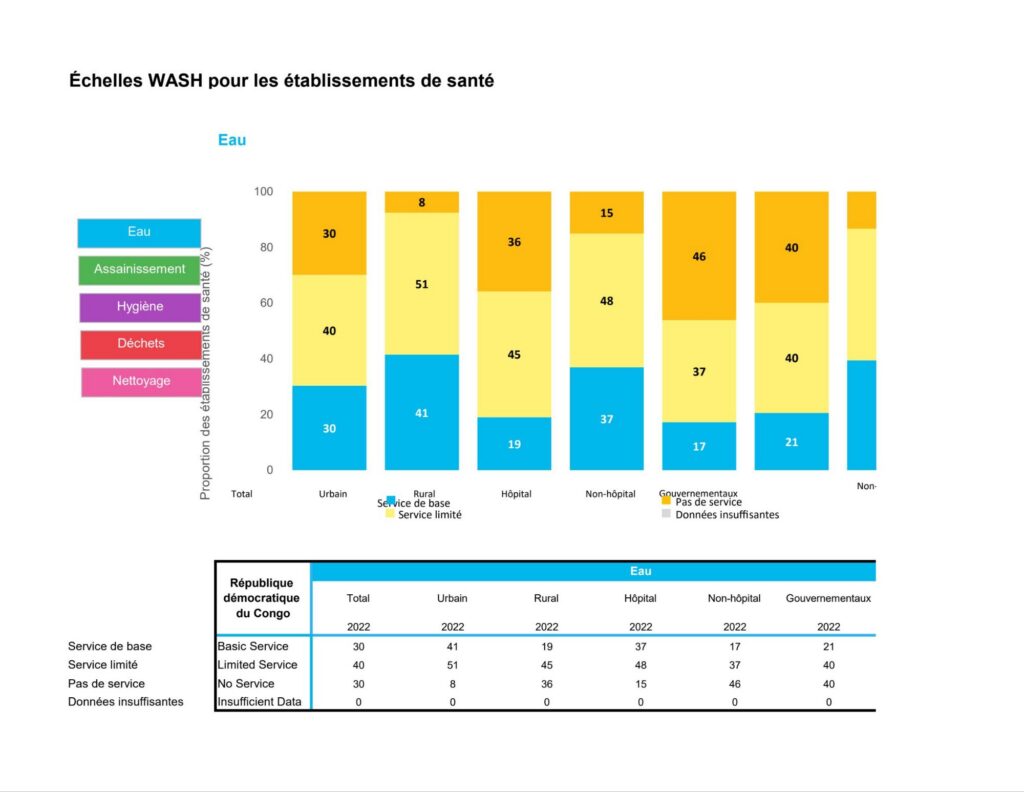
Overall, 30 percent of the population has access to basic water service, 40 percent with limited water access, and 30 percent has no access to improve (safe) water services. Basic water service is defined as “Water is available from an improved source on the premises.” Limited water service is defined as “An improved water source is available within 500 m of the premises, but not all requirements for a basic service are met.” And No water service is defined as “Water is taken from unprotected dug wells, springs or surface water sources, an improved source that is more than 500 m from the premises, or there is no water source.”
For example, the JMP reported 36 percent of the rural population has no water service. And specifically, 15 percent of all hospitals have no water service and 46 percent of other HCFs have no water service. Without access to water, one can understand why mortality rates among mothers and children are so high.
Congo Helping Hands is working to bring basic water service to HCFs and their supported population in the rural setting. Currently, we are managing four HCFs. And we plan to provide two HCFs and their supported community with basic water service later this year.